Product Description
Technical Specification
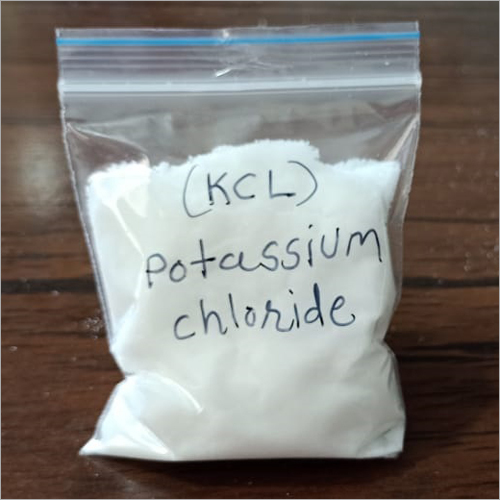
| Appearance | White |
| Melting Point | 770 Degree C |
| Cas Number | 7447-40-7 |
| Formula | KCl |
| Grade Standard | Industrial Grade |
| IUPAC- Name | Sylvite |
| Packaging Type | Poly Pack |
| Packaging Size | 1 Kg |
| Form | Powder |
| Purity | 99.9% |
| Usage/Application | Industrial |
Versatile ApplicationsPotassium Chloride serves multiple industries, from agriculture as a vital fertilizer to healthcare as an electrolyte replenisher. Its use in food processing as an additive and in laboratories as a reagent underscores its essential role in both industrial and scientific settings.
Safe and Reliable HandlingClassified as non-hazardous, KCL Potassium Chloride can be transported and handled under normal conditions. While direct contact with skin or eyes may trigger mild irritation, following standard safety practices is sufficient for general use.
Quality and Packaging OptionsAvailable in 25 kg bags, 50 kg drums, and jumbo bags, Potassium Chloride meets the varying needs of businesses, distributors, and manufacturers. Each batch is produced to a high purity standard, ensuring consistent performance and reliability.
FAQs of (KCL) Potassium Chloride:
Q: How should KCL Potassium Chloride be stored to maximize its shelf life?
A: Store KCL in a cool, dry environment and keep containers tightly closed. Under these recommended conditions, it can maintain its quality and effectiveness for up to 3 years.
Q: What are the main industrial and commercial uses of Potassium Chloride?
A: Potassium Chloride is primarily used in fertilizers, as a pharmaceutical electrolyte replenisher, a food additive, and as a reagent in laboratories. Its high solubility and purity make it suitable for a wide range of applications.
Q: When is it necessary to take precautionary measures while handling KCL Potassium Chloride?
A: Precautionary measures should be taken when handling KCL in situations where contact with skin or eyes may occur, as it can cause irritation. Wearing standard protective gear such as gloves and safety goggles is recommended during handling.
Q: Where is KCL Potassium Chloride commonly applied in food and pharmaceutical industries?
A: In the food industry, it is used as a salt substitute and stabilizer, while in pharmaceuticals, it serves as an electrolyte replenisher in various formulations and intravenous solutions.
Q: What process is involved in using Potassium Chloride as a fertilizer?
A: As a fertilizer, Potassium Chloride is typically applied directly to the soil, providing an essential source of potassium for plants, which aids in overall crop growth and increases yield efficiency.
Q: What benefits does using Potassium Chloride offer in laboratory settings?
A: In laboratories, KCL serves as a strong electrolyte, facilitating accurate and consistent results in chemical analysis, buffer preparation, and standard solutions due to its stability and predictable ionic strength.





 Send Inquiry